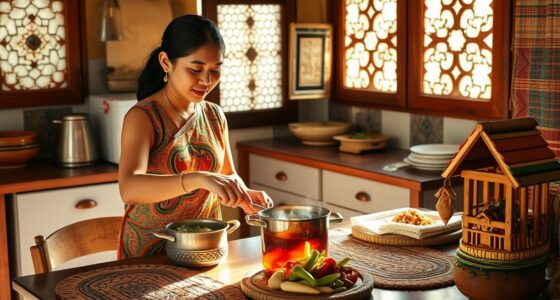
Recent surveys show that Filipino households are shifting toward gender roles that favor shared chores, with men increasingly participating in cleaning, cooking, and other domestic tasks. This change reflects evolving attitudes toward equality and partnership, influenced by education, media, and women’s growing workforce participation. Younger generations see chores as a normal part of family life, strengthening bonds and reducing stereotypes. To discover more about this positive progress, keep exploring how these trends are shaping Filipino family dynamics.
Key Takeaways
- Filipino men increasingly participate in household chores, reflecting a shift towards gender equality in family roles.
- Younger generations view chores as shared responsibilities, fostering respect and cooperation within families.
- Media and educational campaigns promote balanced gender roles, encouraging open communication about domestic tasks.
- Cultural norms are evolving, with chores seen as collective efforts rather than gender-specific duties.
- Survey results indicate a positive trend toward egalitarian family structures and more inclusive household dynamics.

Despite traditional gender expectations, recent survey results reveal a shift in Filipino households regarding house chores. More men are stepping up to share household responsibilities, challenging the long-held notion that chores are solely women’s work. This change reflects a broader transformation in cultural expectations, where equality and partnership become more prominent in family dynamics. You might notice that, increasingly, household responsibilities are becoming a shared effort, with men actively participating in cleaning, cooking, and other domestic tasks. This shift is not just about individual choices but signals a broader cultural movement toward more egalitarian roles within Filipino homes.
Men are increasingly sharing household chores, signaling a shift toward gender equality in Filipino family roles.
Historically, cultural expectations have cast women as the primary caregivers and homemakers, with men positioned as breadwinners. But times are changing. Today’s survey shows that men are more aware of their role in maintaining a balanced household. They’re not just providing financially but also engaging in daily chores that keep the home running smoothly. This evolution in behavior stems from changing attitudes towards gender equality, influenced by education, media, and the increasing participation of women in the workforce. As a result, household responsibilities are no longer viewed through the lens of gender but as shared duties essential for the well-being of the family.
You might also notice that these shifts are more apparent among younger generations. Many young Filipino men now see household chores as a natural part of partnership, rather than a gendered obligation. This attitude encourages a more inclusive environment where both partners contribute equally, fostering respect and cooperation. Families are starting to recognize that dividing chores fairly isn’t just practical but also reinforces the bond between members. It helps break down stereotypes and promotes a culture where everyone feels responsible for creating a comfortable and functional home. Additionally, the rise of social awareness around gender roles supports these positive changes, emphasizing that shared responsibilities benefit the entire family unit.
Moreover, these changes are supported by evolving societal norms that emphasize gender equality. Educational campaigns and media portrayals highlight the importance of shared responsibilities, making it more acceptable and even expected for men to participate actively in household chores. You may find that, in many households, chores are now seen as a team effort, with open communication about who does what. This approach helps manage household responsibilities efficiently and cultivates a more balanced family environment. Ultimately, the survey results reflect a promising trend: Filipino families are moving toward a future where gender roles in house chores are more flexible, equitable, and based on mutual understanding rather than cultural expectations alone.
Frequently Asked Questions
How Has Social Media Influenced Gender Roles in Filipino Households?
You’ve probably noticed how social media influence sparks gender role shifts in Filipino households. It exposes you to diverse perspectives, encouraging more equality and shared responsibilities at home. As you scroll, you see stories that challenge traditional norms, inspiring you to rethink household roles. This digital exposure empowers you to embrace more balanced gender dynamics, fostering a culture where chores and responsibilities are shared more fairly, reflecting evolving societal values.
Are There Regional Differences in Chore Divisions Across the Philippines?
Did you know that in some regions of the Philippines, women spend up to 60% more time on chores than men? Regional stereotypes shape the chore hierarchy, with urban areas often more progressive than rural ones. These differences reflect deeply ingrained cultural norms, making chore divisions vary markedly across the country. Recognizing these regional disparities helps us understand how tradition influences daily responsibilities in Filipino households.
What Impact Do Traditional Values Still Have on Current Chore Assignments?
Traditional values still influence how chores are assigned because cultural expectations shape family dynamics. You may notice that, despite progress, women often handle more household tasks due to longstanding beliefs about gender roles. These expectations can limit shared responsibilities, making it harder to break free from conventional patterns. Recognizing this impact helps you understand the importance of fostering equality, encouraging more balanced chore distribution within Filipino households.
How Do Younger Generations Perceive Gender Equality in Household Tasks?
Think of gender equality in household tasks as a breath of fresh inspiration. You see, younger generations often challenge traditional masculinity norms, believing chores shouldn’t be dictated by gender. They view household expectations as shared responsibilities, not just women’s work. This shift indicates that they’re rewriting the rulebook, emphasizing fairness and partnership rather than outdated gender roles, paving the way for more balanced and equitable homes.
What Policies Could Promote More Equitable Chore Distribution at Home?
To promote more equitable chore distribution at home, you should support gender policies and equality initiatives that encourage shared responsibilities. You can advocate for workplace policies that allow flexible schedules, making it easier for everyone to contribute at home. Additionally, participating in community programs or family dialogues can challenge traditional roles, fostering a culture of fairness. By actively engaging in these efforts, you help create a balanced environment where chores are shared equally.
Conclusion
As you reflect on these survey results, one thing becomes clear—you’re part of a changing story. Filipino homes are shifting, blurring traditional lines and redefining roles. But the question remains: will these new patterns stick? Will everyone embrace this evolving balance? The future of house chores isn’t set in stone, and your choices could shape what’s next. So, are you ready to be part of this exciting transformation?